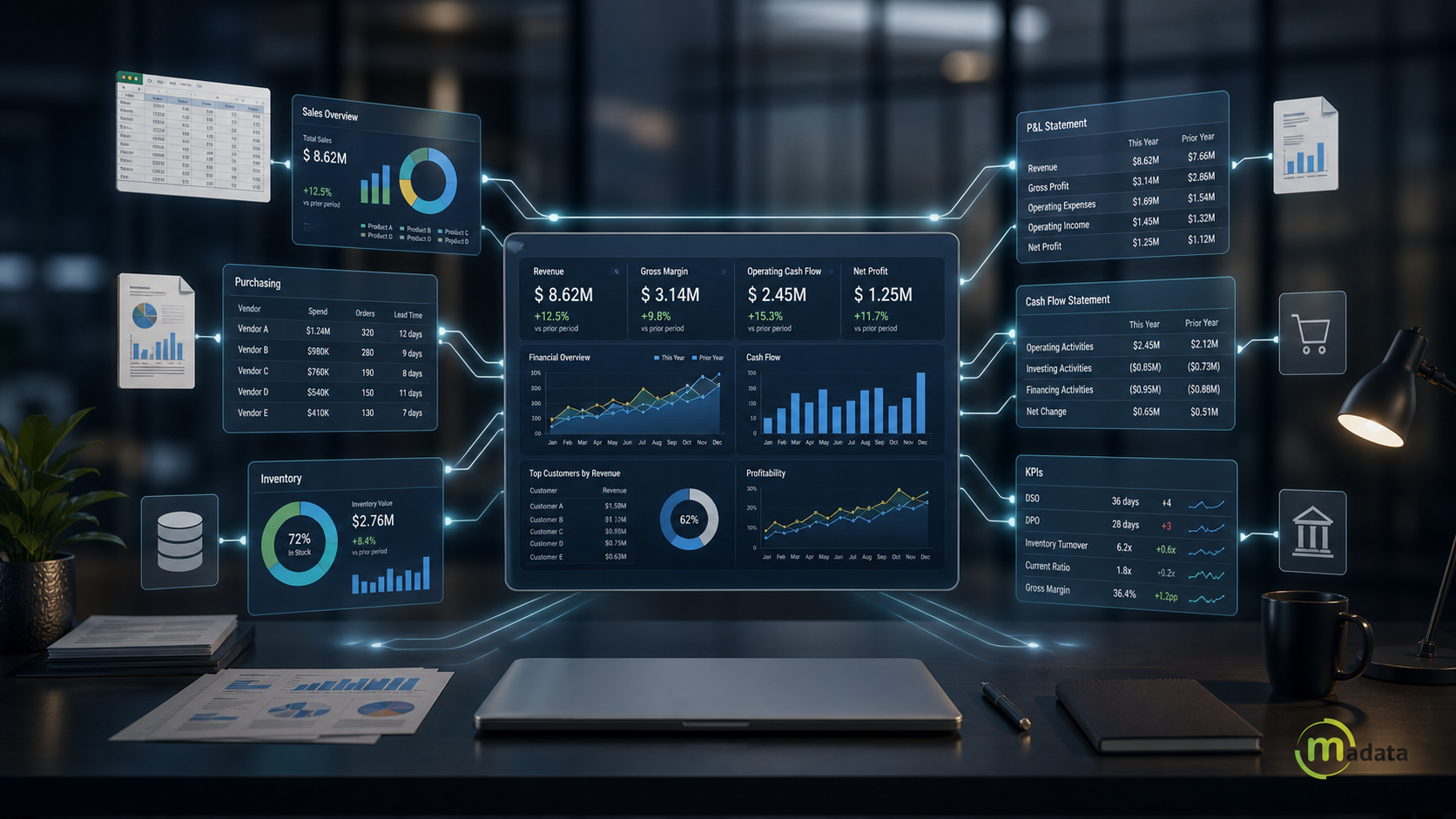

Artificial intelligence is transforming the way companies manage information, automate tasks, and coordinate their operations. However, for medium and large organizations, adopting this technology involves much more than simply purchasing a tool: it requires identifying opportunities, integrating systems, and establishing controls to ensure that solutions meet specific business objectives.
Therefore, when evaluating enterprise AI providers in Mexico, it is important to compare their technical capabilities, their consultative approach, and their experience in taking a solution from assessment through to implementation.
Companies looking to implement artificial intelligence need to understand what type of provider best suits their needs, which processes they can automate, and how to measure the return on investment.
What types of enterprise AI providers are there?
Not all providers offer the same scope of services. Some market artificial intelligence platforms; others specialize in developing customized solutions or integrating the technology with an organization’s existing systems.
Here are some of the main options that Mexican companies can evaluate.
1. Artificial intelligence platform providers
They offer tools and services that enable companies to develop applications, analyze data, or incorporate AI capabilities into various business processes.
They are a good option for organizations with technical teams capable of configuring, developing, and managing their own solutions. However, depending on the platform and the project, it may be necessary to have internal resources to perform integrations, define controls, and maintain the applications.
2. Artificial intelligence consulting firms
Artificial intelligence consulting firms help identify opportunities to apply this technology, assess the feasibility of projects, and define an implementation strategy.
Their involvement can range from process assessment to tool selection, solution design, and results evaluation.
This approach is particularly relevant when a company needs to determine where AI can generate value before investing in a broader implementation.
3. AI Implementation and Integration Providers
These providers focus on turning identified opportunities into functional solutions. They can develop AI agents, connect business applications, and automate workflows involving different systems.
For companies that already use platforms such as ERP, CRM, communication tools, or document management systems, integration is a key factor. The solution must be incorporated into existing processes and adhere to the organization’s permissions, controls, and operating rules.
4. Specialized AI Solution Providers
Some providers develop solutions geared toward specific functions, such as customer service, sales, finance, human resources, or operations.
These options can be useful when a company has a well-defined need. Before choosing them, it’s important to verify whether they can adapt to internal processes, integrate with other applications, and evolve as business requirements change.
How to Compare Enterprise AI Providers in Mexico?
To choose among the different options, it’s advisable to establish evaluation criteria that allow you to compare both technological capabilities and the scope of support provided.
1. Consultative Approach and Business Knowledge
AI implementation must begin with an understanding of how the company operates and what problems it needs to solve.
A provider with a consultative approach analyzes current processes, identifies bottlenecks, and prioritizes automation opportunities based on their impact and complexity.
Before signing a contract, it’s a good idea to ask how the assessment is conducted, what information is required, and how the provider determines whether a process is suitable for incorporating artificial intelligence.
2. Ability to Integrate with Existing Systems
An AI solution may have advanced capabilities, but its business value also depends on the information it can access and the actions it can perform within authorized processes.
Therefore, it’s important to assess whether the provider can connect the solution to tools such as ERP, CRM, email, support platforms, and internal applications.
It’s also a good idea to verify which integration mechanisms are available, what technical restrictions exist, and how future changes will be managed.
3. Security, Permissions, and Traceability
Companies need to maintain control over their data and over the actions performed by AI solutions.
During the evaluation, it is important to review how access is managed, what information each agent can view, how their actions are logged, and what mechanisms exist to monitor results.
For sensitive processes, it may also be necessary to incorporate human approval before executing certain actions. This approach allows companies to leverage automation without eliminating the oversight required for the operation.
4. Ability to Measure Results
The implementation of AI must align with business objectives defined from the outset.
Depending on the process, metrics may include the time required to complete a task, the volume of automated activities, detected errors, response times, or the hours the team can devote to higher-value activities.
A provider should help establish a baseline, define success metrics, and track results. This enables the company to assess the solution’s actual impact and determine whether to expand it to other processes.
5. Post-Implementation Support
The operation of an AI solution does not end when it goes live. Processes change, applications are updated, and new needs may arise.
Therefore, it’s important to understand what monitoring, maintenance, optimization, and support services the provider offers. It’s also important to define who will handle incidents and how adjustments will be made when the rules or the systems involved change.
What processes can companies automate with artificial intelligence?
Enterprise AI solutions can be applied in various areas. The feasibility depends on the workload, data availability, process stability, and the level of control required.
Some examples include:
Sales and business management. An AI agent can research prospects, prepare information for sales outreach, assist in qualifying opportunities, and update records in a CRM, in accordance with defined permissions.
Finance. AI can assist with extracting information from invoices, organizing data, and preparing reports. Processes requiring accounting validations or authorizations must retain the appropriate controls.
Operations. Agents can generate periodic reports, identify situations requiring attention, and send alerts to the appropriate personnel when certain conditions are met.
Support and Customer Service. Technology can classify tickets, suggest responses, and route complex cases to the appropriate team, helping to organize work and streamline service.
Human Resources. Automation can streamline administrative tasks, such as coordinating onboarding activities for new employees and distributing information related to their onboarding processes.
In all cases, the priority should be to select a specific process, evaluate its feasibility, and define how improvement will be measured before expanding the scope.
What does an enterprise AI implementation process look like?
A structured implementation helps reduce uncertainty and keep business objectives aligned with technical decisions.
Although the stages may vary depending on the project, there are five steps worth considering.
1. Process diagnosis. This involves analyzing how the current operation works, which activities are the most time-consuming, and where opportunities for automation exist.
2. Prioritizing opportunities. Potential benefits, implementation effort, risks, and technical dependencies are compared to determine where to start.
3. Solution design. The agent’s tasks, information sources, necessary integrations, permissions, and metrics for evaluating performance are defined.
4. Implementation and testing. The solution is developed or configured, connected to the necessary tools, and its behavior is validated before it goes into production.
5. Monitoring and optimization. Metrics are reviewed, opportunities for improvement are identified, and adjustments are made based on the results and the company’s needs.
This process allows for controlled progress, validates results, and builds an adoption strategy that aligns with the organization’s priorities.
Madata: Enterprise AI Solutions Focused on Operations
At Madata, we help companies identify automation opportunities and design AI agents tailored to address specific business needs.
Our approach begins with a process diagnosis to identify bottlenecks, prioritize opportunities, and define solutions that can be integrated with the tools the organization already uses.
Through Madata AI, we develop and implement agents capable of perceiving information, analyzing context, and executing tasks in accordance with established objectives, rules, and permissions.
Among the capabilities we offer are:
- Diagnosis and prioritization of opportunities: identification of friction points and processes where automation can generate value.
- Agents connected to business tools: integration with applications such as HubSpot, Salesforce, Zendesk, Gmail, Slack, WhatsApp, Notion, and Google Sheets, as well as other systems via API or alternative integration methods depending on technical feasibility.
- Control and traceability: mechanisms such as minimal permissions, activity logs, and human oversight when required.
- Metrics and continuous improvement: performance tracking to evaluate results and identify opportunities for optimization.
Our process includes an in-depth assessment, solution and pilot design, implementation with integrations, and subsequent monitoring. This allows us to establish a scope aligned with each organization’s needs before moving forward with a broader implementation.
How to Choose the Right Provider for Your Company?
The best option isn’t necessarily the one that offers the most tools or the greatest number of features. It’s the one that understands your business processes, can integrate the technology in a viable way, and establishes mechanisms to measure and control results.
Before making a decision, it’s important to define the problem you want to solve, identify the systems involved, assess security requirements, and establish the metrics that will determine the project’s success.
It’s also advisable to start with a pilot project of limited scope, validate its performance, and use the results to decide whether to extend the solution to other areas.
Artificial intelligence can help improve operational efficiency and reduce manual work, but its value depends on an implementation that is aligned with the company’s objectives.
At Madata, we help you identify automation opportunities and evaluate how AI agents can be integrated into your processes. If your organization is looking to move toward a more agile, connected, and measurable operation, learn aboutour enterprise artificial intelligence solutions and let’s discuss your company’s needs.