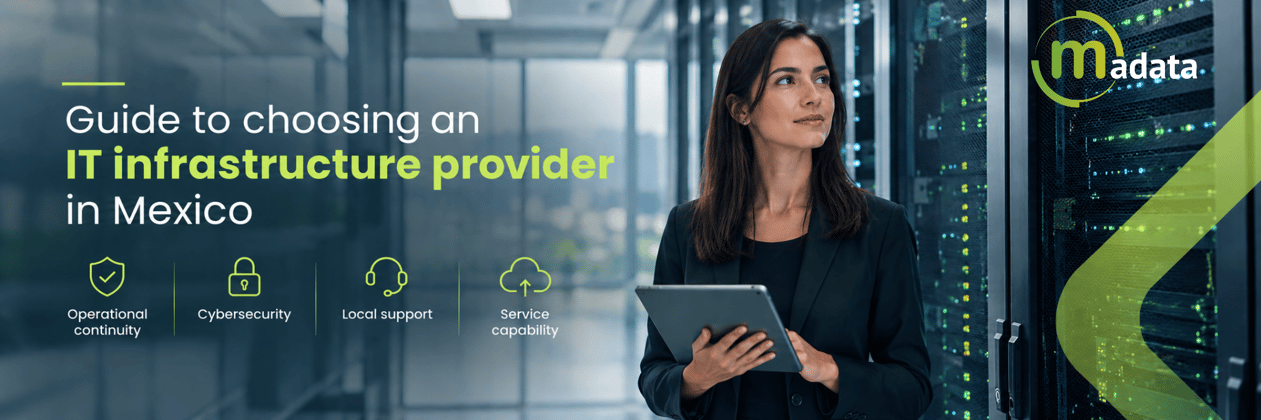
Choosing among different IT infrastructure providers is a decision that goes far beyond comparing prices or brands. Business continuity, information security, support capabilities, and the ability to scale the infrastructure depend, to a large extent, on having a provider that understands the business’s actual needs.
For companies in Mexico, it’s also important to consider factors such as local coverage and support, technical expertise, certifications, the ability to work with different technologies, and the available service models.
In this guide, we share the key aspects you should evaluate when selecting an IT infrastructure provider—from servers, networks, and storage to cybersecurity, cloud, backup, and managed IT services.
What Does an IT Infrastructure Provider Do?
An IT infrastructure provider helps companies design, implement, maintain, and optimize the technological components that support their operations.
This may include:
- Servers and storage.
- Networks and communications.
- Virtualization.
- Data centers.
- Backup and recovery.
- Cloud infrastructure.
- Cybersecurity.
- Technical support.
- Managed IT services.
- Monitoring and business continuity.
Depending on the company’s needs, the provider can be involved in everything from designing a new infrastructure to managing and supporting an existing technology environment.
How to Choose an IT Infrastructure Provider?
The choice should be based on the organization’s actual needs and not solely on the brands or solutions a provider offers.
Here are some of the most important criteria:
1. Evaluate operational continuity
The IT infrastructure must help ensure that critical systems remain available and can be restored in the event of an outage.
When evaluating a provider, it’s a good idea to ask:
- Does the provider have experience in critical environments?
- What backup and recovery mechanisms do they offer?
- How do they approach business continuity?
- Can they design or strengthen disaster recovery plans?
- Do they support hybrid infrastructure?
A provider must understand which systems are critical to the business and what impact an outage would have.
2. Review its cybersecurity capabilities
Infrastructure and security can no longer be analyzed as completely separate elements.
Servers, networks, endpoints, identities, applications, and cloud services are all part of the same technological environment.
Therefore, it is advisable to assess whether the provider has the capabilities to protect and strengthen the infrastructure using cybersecurity technologies and services.
Some areas to review include:
- Network security.
- Endpoint protection.
- Secure and remote access.
- Cloud environment security.
- Network segmentation.
- Secure backup and recovery.
- Threat protection.
3. Consider local support
For a company operating in Mexico, having local assistance and support can be important when an incident arises that requires specialized attention.
Beyond simply asking whether the provider “offers support,” it’s important to know:
- Hours of operation.
- Geographic coverage.
- Response times.
- Incident escalation.
- Remote and in-person support.
- Availability of specialists.
- Support options.
Support can be contracted on a per-project basis, through a pool of hours, as a dedicated resource, or under a managed service model, depending on the organization’s needs.
4. Analyze service capacity
A provider may have excellent products but still not be a good fit if it lacks the capacity to support the operation.
It is important to review their experience in:
- Infrastructure design.
- Implementation.
- Migrations.
- Virtualization.
- Networking.
- Storage.
- Backup.
- Cloud.
- Cybersecurity.
- Support and managed services.
It’s also a good idea to find out if they have certified staff and technology partnerships that support their capabilities.
5. Check their experience with similar companies
Experience is particularly important when the infrastructure supports critical processes.
It’s not necessarily about finding a provider that works exclusively with a single industry, but rather about determining whether they understand similar scenarios in terms of size, complexity, number of users, locations, or the criticality of the systems.
Some useful questions to ask are:
- Have they worked with companies of a similar size?
- Do they have experience with hybrid environments?
- Can you provide references or success stories?
- Do you have specialists in the technologies currently in use?
What should an enterprise technology infrastructure solution include?
There is no one-size-fits-all infrastructure that works for every company. However, a comprehensive assessment typically considers different layers.
| Area | What to evaluate? |
|
Computing |
Servers, capacity, and performance |
|
Storage |
Capacity, Availability, and Scalability |
|
Networking |
Connectivity, Performance, and Segmentation |
|
Virtualization |
Consolidation and Workload Management |
|
Backup |
Data Protection and Recovery |
|
Cloud |
Public, private, or hybrid models |
|
Security |
Infrastructure and Data Protection |
|
Support |
Service, Escalation, and Coverage |
|
Continuity |
Incident and Disaster Recovery |
The goal is not to acquire as much technology as possible, but to build an infrastructure aligned with current and future business requirements.
Infrastructure Provider or Managed IT Services Provider?
These are related concepts, but they are not necessarily equivalent.
An infrastructure provider may be primarily involved in the design, procurement, and implementation of technology.
Managed IT services, on the other hand, may involve ongoing participation in the operation and support of the technology environment.
For example, a company may require only the deployment of new servers or may also need ongoing technical support, user assistance, infrastructure management, or specialized resources.
The appropriate approach will depend on the level of control, expertise, and support the organization needs internally.
What questions should you ask before hiring an IT provider?
Before making a decision, IT managers can use this checklist:
Capacity
- Do they have experience with our infrastructure?
- Do they have certified specialists?
- Can they support our future growth?
Support
- What service levels do you offer?
- What is your coverage?
- How does escalation work?
Security
- What cybersecurity capabilities does it include?
- How does it protect critical infrastructure?
- Does it have experience in incident response?
Continuity
- Can it provide backup and recovery support?
- Do you have experience with disaster recovery?
- How do you help reduce disruptions?
Service
- Do you offer on-site and remote support?
- Do you work on a project basis, by the hour, with dedicated resources, or as a managed service?
- Can you integrate different technologies and vendors?
Evolution
- Can you support migrations or modernizations?
- Do you have experience with cloud and hybrid infrastructure?
- Can you adapt the service as business needs change?
How much does it cost to hire an IT infrastructure provider in Mexico?
There is no single price for IT infrastructure services, as the cost depends on the scope and complexity of the project.
Factors that can affect the cost include:
- Number of users and devices.
- Number of locations.
- Server and storage capacity.
- Network requirements.
- Cloud services.
- Required level of cybersecurity.
- Support hours and coverage.
- Number of specialists needed.
- Contract structure.
- Availability and continuity requirements.
For this reason, comparing prices alone can lead to decisions that are not representative of the full picture. It is recommended to compare the scope, service levels, experience, and technical capabilities of each provider.
What sets a good IT infrastructure provider apart?
Beyond the hardware, software, or brands it offers, an IT infrastructure provider must be able to align technology with business needs.
This involves understanding which processes are critical, where risks lie, what infrastructure the organization needs, and how it can evolve without causing unnecessary disruptions.
For IT directors and managers, some of the most important indicators are:
Continuity + security + support + technical expertise + scalability.
These elements allow you to evaluate providers from a broader perspective than just the initial price of a solution.
Madata: IT Infrastructure and Services for Businesses in Mexico
At Madata, we help organizations design, implement, and strengthen their technology infrastructure by integrating various IT capabilities tailored to the needs of each operation.
Our approach covers areas such as infrastructure, cybersecurity, managed IT services, cloud, virtualization, backup, networking, and specialized support.
In addition, we work with leading manufacturers and technologies to integrate solutions tailored to each company’s requirements.
If you’re evaluating IT infrastructure providers to modernize your environment, strengthen operational continuity, or complement your internal team’s capabilities, we can review your situation and help you identify areas for improvement.
Would you like to review your current infrastructure?

%20Qu%C3%A9%20es%20IT%20as%20a%20Service%20y%20c%C3%B3mo%20puede%20ayudar%20a%20las%20empresas%20a%20alcanzar%20sus%20objetivos.png)
%20Ciberseguridad%20en%20los%20Gobiernos%3B%20Un%20gran%20desaf%C3%ADo%20en%20el%202023.jpg)