
For small and medium-sized businesses, maintaining financial control becomes more complex as sales grow, operations expand, and new sales channels are added. Information begins to be scattered across accounting systems, spreadsheets, and management tools, making it difficult to accurately track costs, profitability, and cash flow.
In this context, choosing an ERP system for SMBs in Mexico can help integrate financial information with day-to-day business activities. However, not all solutions offer the same scope or address the same needs.
Some focus primarily on accounting and invoicing, while others integrate finance, purchasing, inventory, sales, and operations into a single platform.
To make an informed decision in 2026, it’s advisable to compare the options based on four factors: financial control, traceability, tax compliance, and the ability to support the company’s growth.
What should an ERP offer to improve financial control?
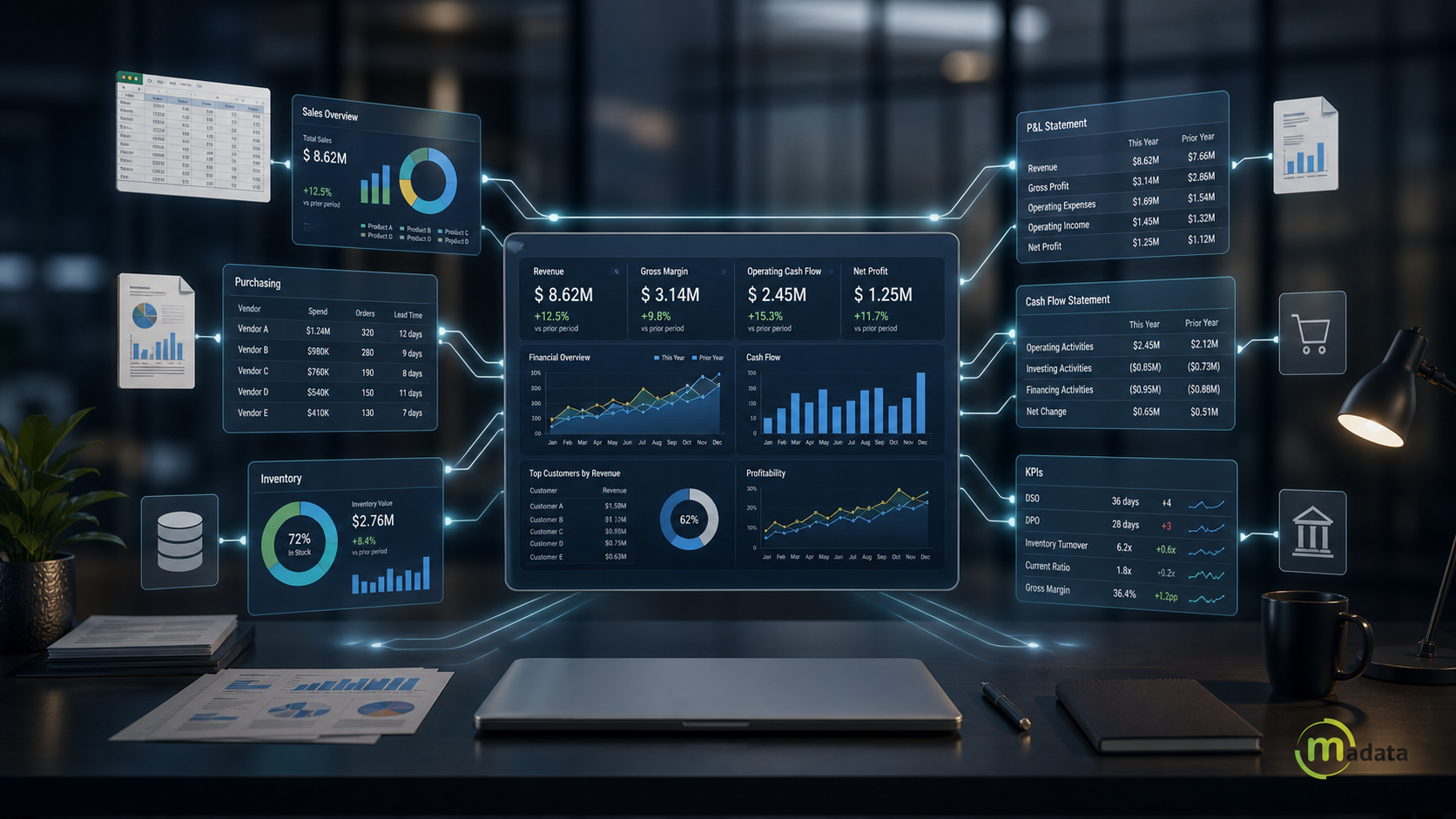
An ERP system, or enterprise resource planning system, connects different areas of the business to centralize information and coordinate processes. When properly configured, it allows you to link business operations to their financial impacts and reduce reliance on manual record-keeping.
To evaluate an ERP system, it’s important to review the following capabilities.
Control of revenue, costs, and profitability. The company needs to know how much it sells, how much it costs to operate, and what margin it earns. An integrated system makes it easier to link sales to the corresponding costs and expenses.
Management of accounts receivable and accounts payable. Visibility into outstanding invoices, due dates, and payment obligations helps manage liquidity and anticipate cash needs.
Cash flow. Accessing up-to-date financial information makes it easier to identify cash inflows and outflows, plan payments, and make decisions well in advance.
Financial reports. Financial statements and management reports must be based on consistent information, with defined recording criteria and verifiable data.
Integration with Operations. Purchases, sales, and inventory movements have financial implications. If each department uses separate systems, consolidating the information may require additional time and lead to discrepancies between reports.
The choice of an ERP system should be based on these requirements and the complexity of the business, not solely on the number of features a platform offers.
Comparison of ERP Systems for SMEs and Mid-Sized Companies in Mexico
The Mexican market offers solutions with different approaches. Some focus on accounting and administrative management, while others aim to integrate broader business processes.
Here are four alternatives worth considering when evaluating financial control.
1. SAP Business One
SAP Business One is designed for small and medium-sized businesses that need to integrate their financial and operational processes. It connects areas such as accounting, sales, purchasing, inventory, and operations, allowing business transactions to be linked to financial information.
Its key features include:
- Integrated accounting and tracking of revenue and costs.
- Management of accounts receivable and accounts payable.
- Inventory control and associated costs.
- Financial reports and business analytics.
- Traceability of transactions and movements.
- Ability to scale the solution as business needs evolve.
This is a particularly relevant option for growing companies that need greater financial visibility and are looking to move beyond management through disconnected systems.
In Mexico, it is important to ensure that the configuration and integrations comply with the tax requirements applicable to the company.
2. Microsoft Dynamics 365 Business Central
Microsoft Dynamics 365 Business Central is a business management solution designed for small and medium-sized businesses. It includes capabilities for finance, sales, purchasing, inventory, and project management, as well as integrations with tools from the Microsoft ecosystem.
It can be an alternative for organizations that use Microsoft 365 and seek to connect their administrative processes with their productivity and analytics tools.
When evaluating this solution, it is advisable to review integration needs, customization requirements, and the scope of tax localization for Mexico.
3. Odoo
Odoo offers a modular platform that allows you to incorporate applications for accounting, sales, purchasing, inventory, CRM, and other business functions.
Its modular approach may appeal to companies looking to start with specific processes and expand the solution as new needs arise.
However, it is important to review which modules, custom developments, and integrations each project requires. The availability of Mexican tax features and their configuration must be verified based on the selected edition, modules, and implementation provider.
4. CONTPAQi
CONTPAQi offers solutions focused on accounting, administrative, sales, and payroll processes, depending on the product purchased.
It can be an option for companies that prioritize accounting management, invoicing, and administrative needs related to Mexican tax compliance.
Before choosing it, it is important to determine whether the selected products also cover the business’s operational requirements or if it will be necessary to connect them with other tools to integrate sales, inventory, purchasing, and finance.
Comparison Table: Which ERP Should You Evaluate Based on Your Financial Needs?
The following table provides a general overview of the strengths and aspects worth evaluating for each option. It does not represent an independent rating nor does it replace a technical evaluation of each product.
| Solution | Main Focus | Financial Control | Aspects to Evaluate |
|---|---|---|---|
| SAP Business One | Integrated business management for small and medium-sized businesses | Finance integrated with sales, purchasing, and inventory | Tax jurisdiction, scope of implementation, integrations, and scalability |
| Microsoft Dynamics 365 Business Central | Business management and integration with Microsoft | Financial management and integration with business processes | Integrations, tax configuration, and customization needs |
| Odoo | Modular platform for various processes | Financial capabilities based on modules and configuration | Required modules, custom development, tax localization, and maintenance |
| CONTPAQi | Accounting, tax, sales, and administrative management depending on the product | Accounting and administrative capabilities based on the contracted solution | Required products, integration between modules, and connection to operations |
The comparison shows that it is not enough to simply identify which system generates financial reports. It is also necessary to determine how well those reports connect to the transactions that generate them and whether the system meets the company’s current and future needs.
How does financial traceability influence the choice of an ERP?
Financial traceability allows you to identify the origin of a transaction, understand how it was recorded, and link it to the corresponding documents and processes.
For example, when a company records a purchase, it needs to be able to link the transaction to the supplier, the invoice, the receipt of goods, the accounts payable entry, and the corresponding accounting entry.
If this data is stored in separate systems, verifying a transaction may require manual inquiries and reconciliations.
An integrated ERP system can streamline this review by linking related documents and transactions within business processes.
When comparing solutions, it’s important to check whether they allow you to:
- Trace the origin of accounting transactions.
- Link invoices to purchases, sales, and payments.
- Identify changes and view activity logs based on available features.
- Reconcile financial information with operational transactions.
- Generate consistent reports for internal reviews and audits.
Traceability does not depend solely on the software. It also requires reliable data, well-structured catalogs, consistent recording rules, and clearly defined responsibilities.
Tax Compliance in Mexico: What to Consider Before Choosing
Tax compliance is an essential requirement for any Mexican company. However, having an ERP system does not automatically guarantee compliance with all tax obligations.
The solution must be configured according to the company’s operations, the tax documents it uses, and the requirements applicable to its business.
Before signing a contract, it’s a good idea to verify the following points.
Electronic invoicing. Review how CFDI invoices are generated and managed, what certification or stamping mechanisms are used, and how cancellations, replacements, and supplements are handled when applicable.
Electronic accounting. Confirm that the solution and its configuration allow the company to meet the requirements applicable to accounting records and the information that must be submitted to the tax authority.
Addenda and special transactions. If the company conducts transactions that require specific tax addenda, verify their availability and the conditions for implementing them.
Updates and maintenance. It is important to understand how regulatory changes are addressed and what responsibilities fall to the manufacturer, the implementation provider, and the internal team.
Integration with financial processes. Tax information must be consistent with accounting records, accounts receivable, accounts payable, and business transactions.
The evaluation should focus on the specific solution, its modules, and its configuration for Mexico. Capabilities may vary depending on the edition, integrations, and components purchased.
Which ERP is best for a growing SME?
The answer depends on the level of operational complexity, financial needs, and growth objectives.
A company that primarily requires accounting and invoicing may have different needs than an organization that manages multiple warehouses, production operations, recurring purchases, and different sales channels.
To guide the decision, it’s helpful to consider three scenarios.
Companies with specific accounting and administrative needs. They can prioritize solutions that cover their current tax, accounting, and sales processes, provided the scope is sufficient for their operations.
SMEs seeking to integrate multiple areas. If finance, purchasing, sales, and inventory need to share information, it’s advisable to evaluate an ERP system that connects these processes and reduces manual reconciliations.
Medium-sized companies with greater operational complexity. When there are multiple branches, specialized processes, higher transaction volumes, or more demanding traceability requirements, it is important to evaluate the system’s integration capabilities, reporting features, scalability, and vendor support.
In these latter scenarios, SAP Business One can be a relevant alternative due to its integrated business management approach.
Why Consider SAP Business One for Financial Control?
SAP Business One allows you to connect accounting with a company’s business and operational processes. This makes it easier for departments to work with related information and gives financial managers greater visibility into business transactions.
Key capabilities for financial management include accounts receivable and accounts payable management, tracking revenue and costs, cash flow control, and financial reporting.
Furthermore, by integrating purchasing, sales, and inventory, it allows you to link daily activities to their financial impacts, rather than relying solely on separately generated reports.
For companies seeking to grow with greater control, this integration can help reduce data duplication, improve traceability, and facilitate decision-making.
The outcome depends on an implementation aligned with the organization’s processes, the quality of the data, and the correct configuration of the solution.
Madata: SAP Business One Implementation for Growing Companies
At Madata, we help companies integrate their processes using SAP Business One, with a focus on financial control, operational visibility, and business growth.
Our work begins with understanding each organization’s needs to determine how the solution should be configured, which processes should be integrated, and what information management needs to make decisions.
With SAP Business One, companies can connect finance, sales, purchasing, inventory, and operations on a single platform. This establishes a more consistent foundation for tracking revenue, costs, profitability, and cash flow.
The implementation must also take into account the data structure, tax requirements, necessary integrations, and user training. These elements are essential for ensuring that the technology adapts to actual operations and does not become an isolated tool.
If your company needs to improve its financial control and integrate its operations, at Madata we can help you assess how SAP Business One can meet your needs. Let’s discuss your business processes and the opportunities for achieving more integrated and reliable management.
https://meetings.hubspot.com/paulina-reyes2