
Choosing the right technology infrastructure can determine your company’s scalability, security, and profitability in the coming years.
Assessing your actual infrastructure needs: the starting point for a strategic decision
The choice between an on-premises data center, colocation, or cloud solutions should not be based on market trends or impulsive decisions, but rather on a rigorous analysis of your organization’s actual needs. This strategic assessment requires a thorough understanding of the current state of your technology infrastructure, your short- and long-term business objectives, and the resources available for investment and ongoing operations.
The first step is to conduct a detailed assessment that considers multiple dimensions: the volume and type of current workloads, business growth projections, availability and business continuity requirements, regulatory compliance needs, and the technical capabilities of your internal team. It is essential to assess whether your organization requires full control over the hardware and physical infrastructure, or whether it can benefit from the flexibility and scalability offered by more dynamic models.
In addition, this analysis must include an honest assessment of the Total Cost of Ownership (TCO) over time, considering not only the initial investment but also operating expenses, energy consumption, technology upgrades, staff training, and costs associated with preventive and corrective maintenance. At Madata, we support IT, infrastructure, operations, and finance directors and managers in this evaluation process by providing infrastructure and vulnerability analyses that enable them to make informed decisions aligned with the organization’s strategic objectives.
The right decision is not the same for every company. Organizations with predictable workloads, strict regulatory compliance requirements, and specialized technical teams may find value in operating their own data center. Those seeking a balance between control and managed infrastructure may consider the colocation model. And companies that prioritize agility, scalability, and digital transformation may lean toward cloud solutions or hybrid models that combine the best of both worlds.
On-Premises Data Center: Full Control with Significant Investment and Operational Responsibility
An on-premises data center represents the traditional option, where the organization fully owns and manages its technology infrastructure. This model provides the highest level of control over all aspects: from hardware selection and network configuration to security policies and operational procedures. For companies with critical workloads, specific regulatory requirements, or extreme customization needs, this alternative can be strategic.
The main advantages include absolute control over the physical and logical infrastructure, unlimited customization capabilities to adapt to specific business needs, no reliance on external providers for day-to-day operations, and the ability to optimize the infrastructure for specific workloads. Furthermore, for organizations that already have specialized and experienced technical teams, an in-house data center can serve as a natural extension of their internal capabilities.
However, this option entails significant challenges that must be carefully evaluated. The initial investment is considerable, including the acquisition or construction of physical facilities, cooling and power systems, physical security equipment, server hardware, storage, and networks. Recurring operating costs include electricity consumption, equipment maintenance, software licenses, specialized staff available 24 hours a day, and periodic technology upgrades to prevent obsolescence.
Operational responsibility also involves ensuring high availability, implementing business continuity and disaster recovery plans, maintaining the physical and logical security of the facilities, and complying with environmental and safety regulations. At Madata, we offer specialized services in infrastructure modernization, virtualization, and data center infrastructure that enable organizations with their own data centers to optimize their resources, improve operational efficiency, and ensure the continuous availability of critical services through virtualization technologies, platform management, and proactive monitoring.
Colocation: The Balance Between Physical Infrastructure and Specialized Managed Services
The colocation model represents an intermediate alternative in which organizations retain ownership of their hardware but house their equipment in specialized facilities operated by third-party providers. This approach allows companies to benefit from enterprise-class infrastructure—including redundant power systems, advanced cooling, high-speed connectivity, and robust physical security—without the need to build and maintain their own facilities.
Among the main advantages of colocation are a significant reduction in initial investment compared to an in-house data center, access to professional physical infrastructure with availability certifications, flexibility to scale physical space according to growth needs, and high-quality connectivity with multiple telecommunications operators. Organizations retain control over their hardware and configurations but delegate responsibility for the physical infrastructure to a specialized provider.
This model is particularly well-suited for companies that require control over their specific hardware for regulatory compliance or custom configurations but do not wish to shoulder the operational burden of managing physical facilities. It is also an option for organizations transitioning to the cloud that need to keep certain systems on-premises during the migration period.
However, colocation has limitations that must be considered. While it reduces investment in physical infrastructure, organizations remain responsible for the procurement, maintenance, and upgrading of their hardware. Connectivity and bandwidth costs can increase significantly depending on the volume of data transferred. Additionally, physical access to the equipment is subject to the colocation provider’s policies and schedules. It is important to note that colocation is not part of Madata’s service portfolio; however, we recognize its relevance as a market model and can guide organizations in evaluating alternatives that best suit their specific needs.
Cloud Solutions: Scalability, Agility, and Digital Transformation with Hybrid Models
Cloud solutions have radically transformed the way organizations design, implement, and operate their technology infrastructure. This model eliminates the need for investment in physical hardware and allows companies to access computing resources, storage, and application services on demand, paying only for what they use. The cloud is a key enabler of digital transformation, providing the agility and scalability needed to respond quickly to market changes and business demands.
The advantages of cloud solutions are numerous and significant: elimination of the initial investment in physical infrastructure, virtually unlimited scalability to accommodate business growth, high availability with guaranteed service level agreements (SLAs), global access from any location with internet connectivity, and automatic security and functionality updates. In addition, the cloud allows organizations to experiment with new technologies and services without committing to large investments, thereby accelerating innovation cycles.
At Madata, we are certified specialists in the implementation of cloud solutions, including the ability to run SAP S/4HANA in cloud environments. We offer access to world-class virtualization solutions, advanced security, and hybrid architectures that enable our clients to transform their infrastructures into agile, scalable, and secure ecosystems. Our services range from cloud architecture consulting and design to workload migration, integration with existing systems, and ongoing platform management.
Hybrid models represent a natural evolution that combines the best of on-premises infrastructure and the public cloud. This strategy allows organizations to keep sensitive workloads or those with specific regulatory requirements on their own or private infrastructure, while leveraging the flexibility and scalability of the public cloud for less critical applications, development and testing environments, or to handle spikes in demand. Madata supports organizations in designing and implementing hybrid strategies that optimize costs, improve technological resilience, and ensure business continuity by providing data backup services, ITaaS (IT as a Service), and comprehensive platform management that ensure proper operation 24 hours a day, 7 days a week.
Decision Criteria for 2026: Costs, Security, Compliance, and Business Growth
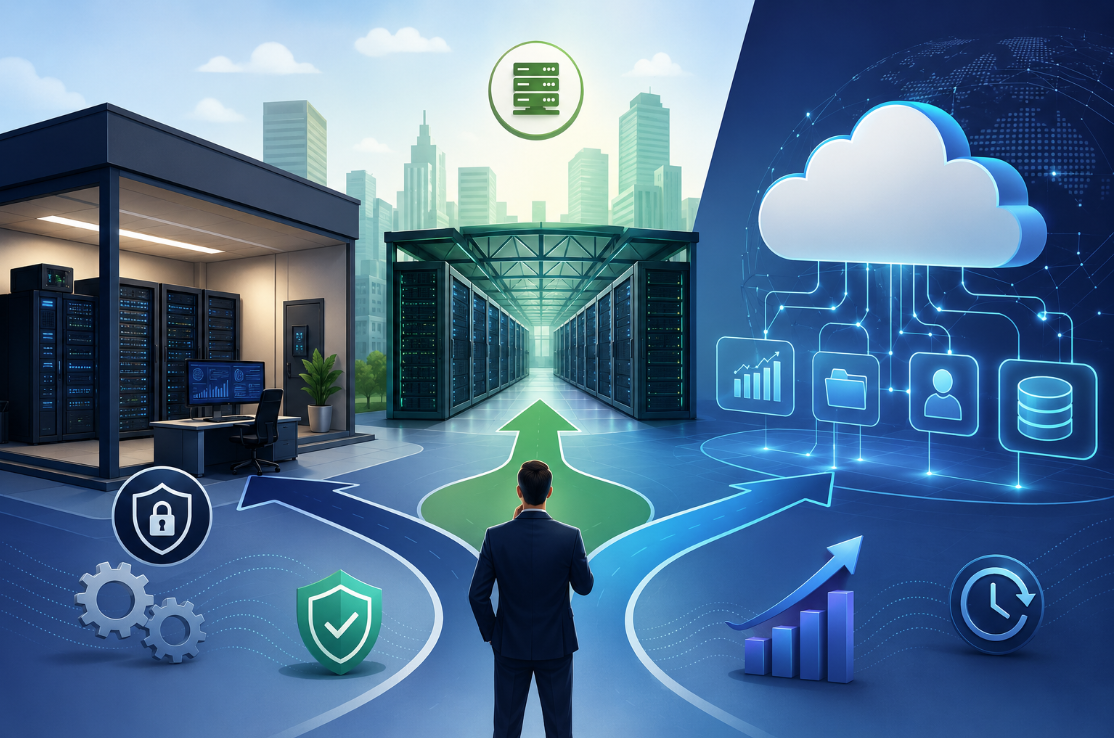
Choosing the right infrastructure strategy for 2026 requires a comprehensive and strategic evaluation of multiple criteria. The first key factor is the analysis of Total Cost of Ownership (TCO), which must consider not only the initial investment but also ongoing operating expenses, specialized personnel costs, energy consumption, technology upgrades, and expenses associated with hardware obsolescence. It is essential to project these costs over a 3- to 5-year period to obtain a realistic comparison between the different options.
Security and regulatory compliance are another critical pillar of the decision-making process. Organizations must assess their specific requirements for data protection, privacy, information sovereignty, and compliance with industry-specific regulations. Depending on the industry and geographic location, there may be restrictions on where and how certain types of data are stored. At Madata, we implement robust protection against cyber threats by designing security architectures aligned with actual business needs, applying principles of continuous monitoring and proactive protection that ensure operational confidence and peace of mind.
Scalability and projected business growth should also significantly influence the decision. Rapidly growing organizations or those with fluctuating demands will benefit from the flexibility offered by cloud solutions, while companies with stable and predictable workloads may find greater efficiency in optimized on-premises infrastructure. The ability to respond to market changes, the launch of new products or services, and geographic expansion are factors that determine which infrastructure model will provide the necessary agility.
Finally, availability and business continuity must be central to the evaluation. The recovery time objective (RTO) and recovery point objective (RPO) defined by the organization will determine the requirements for redundancy, backup, and disaster recovery. Madata offers specialized services in business continuity, data backup, and proactive monitoring that minimize downtime and ensure operational resilience. Our more than 20 years of experience working with companies in Mexico and the United States, combined with our SAP, ITIL, and ISO 20000:1 certifications, enable us to provide comprehensive support in the assessment, design, implementation, and continuous evolution of technology infrastructure.
A well-defined infrastructure strategy—based on rigorous analysis and aligned with the business’s strategic objectives—drives operational efficiency, strengthens technological resilience, and facilitates digital transformation. In an increasingly competitive and dynamic business environment, technology infrastructure is no longer merely an operational support system but has become a strategic enabler that determines an organization’s capacity for innovation, growth, and sustainable success. The right decision is neither unique nor definitive; rather, it must evolve as business needs change, and having a strategic partner like Madata allows you to navigate this evolution with confidence and measurable results.
Ready to define the best infrastructure strategy for your company? At Madata, we analyze your needs and guide you through the design and implementation of solutions that drive business continuity, growth, and digital transformation. Contact us and let’s start building the next phase of your infrastructure!
https://meetings.hubspot.com/spinal