Implementing SAP is one of the most important technology projects for any organization. After months of planning, configuration, testing, and training, the long-awaited Go Live arrives—the moment when the system begins to operate and support critical business processes.
However, there is a very common misconception: the idea that the project ends once SAP goes live.
The reality is that Go Live marks the beginning of a new phase. From that point on, the challenge shifts from implementing the system to keeping it stable, responding to business needs, and ensuring it continues to deliver value as the company evolves.
The real challenge begins after implementation
During the first few weeks or months, it’s normal for issues to arise that weren’t always detected during the project.
Users begin to use the system in real-world scenarios, new requirements emerge from different departments, and the business continues to evolve.
It is common to encounter needs such as:
- Functional adjustments resulting from new processes.
- Issues that affect daily operations.
- Requests for improvements from users.
- Regulatory or tax changes.
- Integrations with new platforms.
- Business growth requiring new features.
All of this is part of the natural life cycle of SAP.
For this reason, keeping the system up to date and properly supported is just as important as the implementation itself.
When an incident is no longer just an IT problem
Many organizations believe that an SAP incident affects only the IT department.
In reality, the impact often extends to the entire company.
An ERP issue can prevent a buyer from generating purchase orders, delay production due to a lack of materials, halt invoicing, affect financial closings, or cause delays in the supply chain.
In other words, when SAP goes down, so can the business.
That’s why having adequate response times and specialists who understand both the platform and business processes is essential to minimizing the impact of any incident.
Five Signs That Your Support Model Could Use an Upgrade
It’s not always obvious when a support model needs to be strengthened. However, there are some indicators that tend to recur in organizations already using SAP.
1. Incidents keep recurring
Resolving a ticket doesn’t always mean fixing the root cause of the problem. When the same issue keeps happening, it’s probably time to review your support model.
2. The internal team spends more time putting out fires than innovating
When internal specialists focus their efforts on handling daily incidents, improvement projects, automation, or digital transformation often take a back seat.
3. Users wait too long to receive assistance
Efficient support not only responds quickly; it also understands the priority of each incident and its impact on the business.
4. Improvements are constantly postponed
As the organization grows, SAP must also evolve. If improvement requests remain pending for months, the current system may no longer have sufficient capacity.
5. There are no metrics to measure service performance
Having service level agreements (SLAs), metrics, and tracking mechanisms allows you to assess support performance and ensure consistent service.
SAP support must do more than just resolve incidents
For many years, ERP system support focused primarily on addressing tickets when a problem arose.
Today’s needs are different.
Organizations are looking for teams capable of keeping pace with the evolution of their platform, proposing improvements, optimizing processes, and supporting business units as new requirements arise.
A modern support model typically includes activities such as:
- First-, second-, and third-level functional support.
- Incident resolution.
- Change management.
- Continuous improvement.
- Process optimization.
- User support.
- Development of functional and technical adjustments.
- Monitoring through service level agreements.
In other words, the goal is no longer simply to keep SAP running, but to help it continue to generate value for the organization.
When does it make sense to rely on an SAP AMS service?
Some organizations have highly specialized in-house teams; others prefer to rely on an external partner to complement their capabilities, handle specific projects, or provide support during periods of increased workload.
An Application Management Services (SAP AMS) solution can be particularly useful when an organization seeks to: reduce response times, access certified specialists, free up the internal team’s workload, implement continuous improvements, gain greater visibility into support performance, and ensure the continuity of critical processes.
Rather than replacing the internal team, the goal is typically to strengthen it and provide specialized support as business needs evolve.
Implementation is just the beginning
Technology and business processes are constantly changing. Therefore, a platform like SAP must evolve at the same pace as the organization.
Having an appropriate support model allows the organization to respond more quickly to new needs, maintain system stability, and ensure that the investment continues to generate results for years to come.
Ultimately, the success of SAP depends not only on having implemented the system correctly, but also on the organization’s ability to keep it aligned with its business strategy.
What characteristics should a good SAP support service have?
At Madata, we support organizations already using SAP S/4HANA, SAP ECC, SAP SuccessFactors, SAP Concur, and the SAP Business Technology Platform (BTP) through specialized SAP AMS services.
Our team provides functional support, incident resolution, continuous improvements, ABAP support, and guidance for the evolution of SAP environments through flexible models such as hourly packages or flat-rate monthly fees, backed by Service Level Agreements (SLAs).
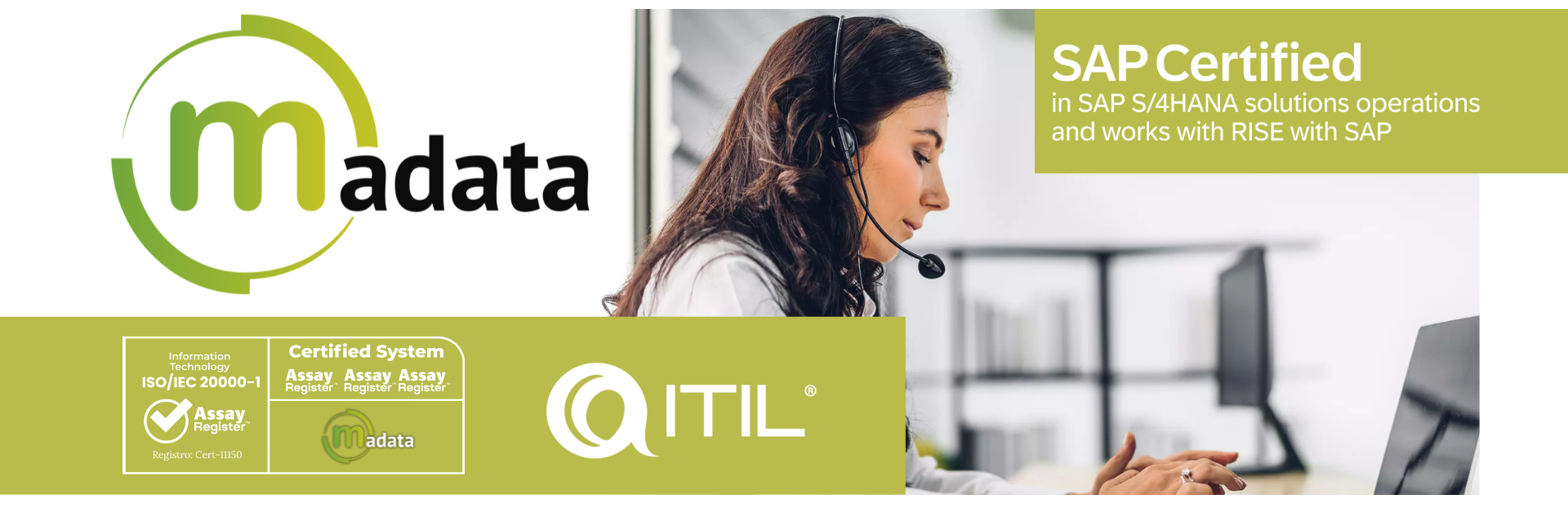
In addition, Madata is SAP-certified for Solution Operations and Support for SAP S/4HANA and RISE, demonstrating its ability to manage and support SAP environments in accordance with audited standards.
If you’d like to learn how to strengthen support for your SAP environment, contact us and let’s discuss your organization’s needs.
https://meetings.hubspot.com/spinal