
Find out when it makes sense to outsource IT, what costs and risks are involved in maintaining it in-house, and how to choose the right model for your company.
When Is It Time to Outsource IT?
Information technology management is a strategic asset for any modern organization. However, maintaining an in-house IT department isn’t always the most efficient option from the perspective of total cost of ownership and business continuity.
For CEOs and CFOs, this decision must go beyond simply reducing payroll. It involves assessing the real impact on operations, the risks associated with technological dependence, and the ability to scale as the business grows. Outsourcing IT should be considered when internal resources no longer guarantee the availability, security, and efficiency that operations require.
This analysis takes on particular importance in an environment where technology outages have a measurable and direct impact on revenue. The question is not whether the company can maintain an in-house IT department, but whether that model ensures operational continuity, access to up-to-date expertise, and a favorable return on investment.
Outsourcing also does not mean losing control over technology. A properly structured managed services model allows you to maintain visibility and IT governance, while a specialized team takes over the operation and support of the agreed-upon functions.
Signs that your current IT model needs to evolve.
There are clear indicators that signal when an in-house IT model has reached its operational limits. Overreliance on one or two key individuals poses a significant risk: if these employees are absent, resign, or take vacation, operations can be compromised without adequate coverage.
Another common symptom is a lack of specialists in critical areas such as cybersecurity, virtualization, or ERP management. When the in-house team responds only reactively to incidents, with no time to implement improvements or prevent problems, the company is operating in “technological survival mode.”
Sustained cost growth without a proportional improvement in service, recurring problems that resurface without a definitive resolution, and the difficulty in scaling the infrastructure as the business grows are clear signs that the current model needs to evolve toward a more robust and specialized structure.
The true cost of maintaining IT in-house.
A financial assessment of IT must consider not only how much it costs to operate the department, but also how much it costs the business when the department lacks the necessary capacity to respond.
The calculation of the cost of an in-house IT department is often limited to salaries and benefits, without considering the full spectrum of associated expenses. Beyond payroll, costs such as ongoing training, software licensing, server infrastructure, monitoring and backup tools, as well as physical space and related services, must be included.
Hidden costs represent an even more significant component. Unproductive hours during learning periods or when resolving complex problems, downtime when there are no incidents to address, errors resulting from a lack of expertise, and costs associated with staff turnover (recruitment, training replacements, loss of institutional knowledge) directly impact profitability.
Additionally, every IT incident generates secondary costs: lost productivity in other areas, an impact on the customer experience, potential lost sales, and reputational damage. These elements are rarely accounted for in the IT budget, but they represent a real financial burden that must be considered when evaluating the total cost of maintaining an in-house technology operation.
Operational Risks of IT Management Without Specialized Support.
Reliance on internal talent is one of the most critical risks to operational continuity. When technical knowledge resides with only a few individuals, the organization becomes vulnerable to any contingency affecting these key employees. This concentration of knowledge creates single points of failure that can paralyze critical operations.
Technological obsolescence poses another significant risk. Without constant access to specialized training and up-to-date certifications, the in-house team may fall behind industry best practices, new cybersecurity threats, and emerging technologies that could benefit the business.
Security vulnerabilities multiply when there are no specialists dedicated to continuous monitoring and threat response. The lack of 24/7 coverage leaves windows of exposure where critical incidents can escalate without an immediate response. Finally, the difficulty in responding effectively to major contingencies (natural disasters, cyberattacks, infrastructure failures) jeopardizes the very survival of the business.
To reduce these risks, organizations can supplement their internal capabilities with Madata’s specialized services—such as monitoring, support, infrastructure, cybersecurity, and business continuity—depending on their business-critical functions.
In-house team, managed service provider, or hybrid model?
The fully dedicated in-house team model is suitable for organizations with highly specialized technology operations and unique requirements that justify investing in dedicated talent. This approach provides total control over processes and priorities but requires a significant investment in recruitment, training, infrastructure, and staff retention.
The managed service provider model transfers full responsibility for IT management to an external specialized partner. This option is ideal for companies seeking cost predictability, access to multidisciplinary expertise, extended coverage, and the ability to focus internal resources on activities that add greater value to the business. The provider assumes responsibility for availability, security, updates, and incident resolution under defined service level agreements.
The hybrid model is often particularly useful when an organization wishes to retain strategic business knowledge internally while delegating specialized operations to an external team.
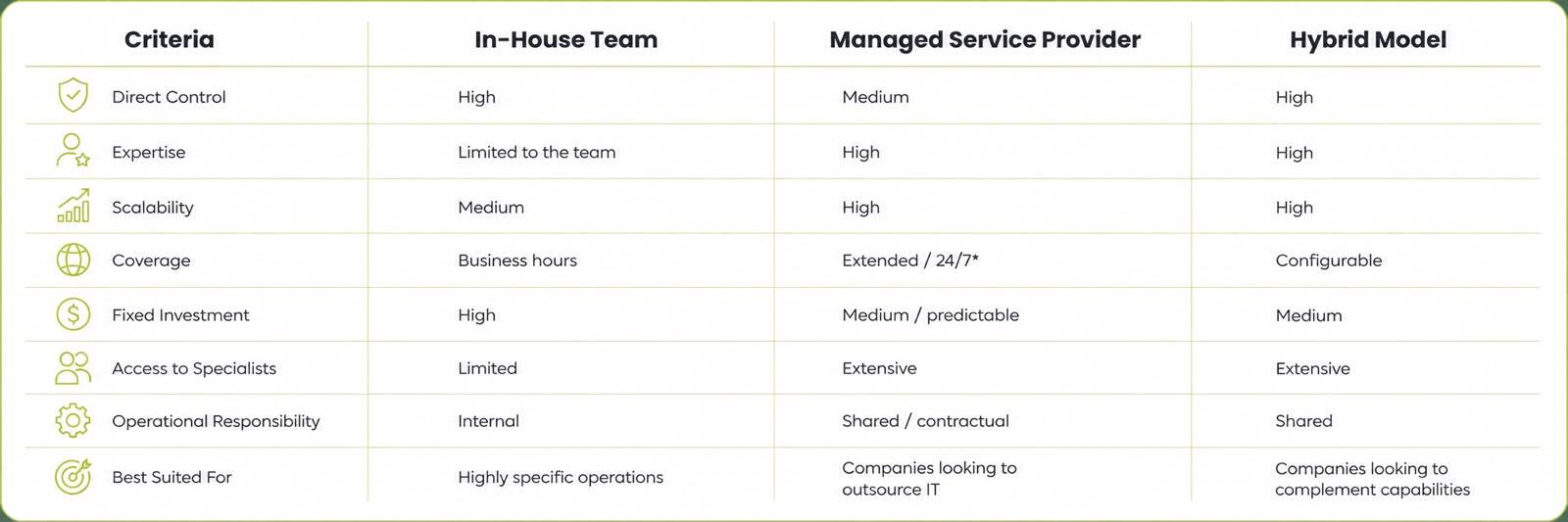
Comparison of IT Management Models.
From a cost perspective, the in-house model requires a fixed investment regardless of actual service demand, while the managed service provider offers predictable structures with payment based on services consumed. The hybrid model combines both approaches, allowing for investment optimization according to the specific needs of each area.
In terms of operational control, the in-house team provides direct oversight of all activities; the managed service provider operates under SLAs with defined performance metrics; and the hybrid model maintains control over critical functions while delegating specialized areas. Technical specialization varies significantly: an in-house team is limited to its current competencies; a managed service provider has access to multiple certified specialists; and the hybrid model combines institutional knowledge with external expertise.
Scalability represents a fundamental difference: adding capabilities internally requires lengthy hiring and training processes, while a managed service provider can scale services quickly based on demand. Hourly coverage also varies: in-house teams operate during standard business hours unless additional investment is made; providers offer extended or 24/7 coverage as part of the service; and hybrid models can be structured according to specific needs. Finally, responsibility for availability and compliance rests entirely with the organization when using in-house teams, is contractually transferred to the provider in managed models, and is distributed according to roles in hybrid models.
How to Calculate the Cost of an IT Outage.
Quantifying the financial impact of a technology outage enables informed decisions regarding investments in IT infrastructure and services. A basic formula for estimating this cost takes into account multiple factors that directly affect business results.
The following formula is provided for illustrative purposes only. Internal costs may vary significantly from one company to another, depending on their organizational structure, operations, resources, and specific business conditions:
The basic formula is: Downtime Cost = (Revenue per Hour × Duration of Outage) + (Affected Employees × Cost per Work Hour × Duration) + Recovery Costs + Losses Due to Impact on Customers. For example, a company with annual revenue of $50 million pesos ($50,000,000 ÷ 8,760 hours per year = $5,708 per hour) that experiences a 4-hour outage faces a direct loss of $22,832 in revenue.
Adding 50 affected employees at an average labor cost of $200 per hour for 4 hours ($40,000), plus technical recovery costs estimated at $15,000, and considering a conservative estimate of $20,000 in impact on customer experience and potential contract losses, the total cost of a single 4-hour outage reaches $97,832. This figure illustrates why investing in managed services with high-availability SLAs is financially justifiable given the risk of frequent or prolonged outages.
What to Evaluate Before Choosing an IT Service Provider.
The selection of a managed IT service provider should be based on objective criteria that ensure alignment with business needs. Proven experience in the organization’s specific industry and in projects of similar complexity is essential. Requesting documented success stories and verifiable references provides tangible evidence of actual capabilities.
Service Level Agreements (SLAs) must clearly specify response times, guaranteed availability, performance metrics, and consequences for non-compliance. Service hours must align with operational needs: extended hours for single-shift operations, and 24/7 coverage for businesses with continuous operations. Security capabilities—including continuous monitoring, incident response, vulnerability management, and regulatory compliance—should not be considered optional but rather essential requirements.
The provider’s scalability to grow alongside the business, relevant technical certifications (ITIL, ISO 20000, vendor certifications such as SAP and VMware), the quality of technical support with defined response times, and transparency in the cost structure with no hidden fees round out the evaluation framework. Additionally, the provider’s ability to integrate with existing systems and its focus on knowledge transfer and empowering the internal team distinguish strategic partners from mere transactional providers.
Remember:
□ Do they have verifiable experience with similar companies?
□ Do they define SLAs and response times?
□ Do they offer coverage appropriate for the operation?
□ Do they have certified specialists?
□ Can they scale as the company grows?
□ Do you have documented processes?
□ Does it have security and business continuity capabilities?
□ Is the cost structure transparent?
□ Can it integrate with the internal team?
□ Does it provide performance metrics and reports?
□ Does it have verifiable references and success stories?
IT Outsourcing as a Strategic Business Decision.
Outsourcing IT services goes beyond the tactical goal of cost reduction to become a strategic decision that impacts the organization’s competitiveness and growth potential. It frees up financial resources and internal talent to focus on activities that directly drive competitive differentiation.
From the CFO’s perspective, transforming fixed costs into variable costs provides budgetary flexibility and improves financial predictability. Access to specialized expertise without the investment required to build those capabilities internally accelerates the adoption of emerging technologies that can generate tangible competitive advantages.
For the CEO, having a technology partner that assumes contractual responsibility for the availability, security, and performance of the technology infrastructure reduces critical operational risks and allows the CEO to focus on business strategy with confidence that the technology platform will operate consistently. The ability to scale services quickly to support growth, new lines of business, or geographic expansion becomes a strategic enabler rather than an operational constraint.
The goal should not simply be to replace internal resources, but to build a more resilient, measurable, and scalable technology operation by combining internal capabilities with external specialists when the business requires it.
Conclusion: What IT Model Does Your Company Need?
There is no one-size-fits-all answer when it comes to choosing the right IT management model. It depends fundamentally on the size of the organization, the complexity of its technology operations, its current level of digital maturity, its growth objectives, and its available investment capacity.
Rapidly growing companies, organizations with limited internal resources or a lack of expertise in critical areas, and businesses where technology supports essential operations but is not the core product generally derive greater value from managed or hybrid models that provide access to enterprise-grade capabilities without the investment and risk of building them in-house.
The fundamental question that CEOs and CFOs must answer is: Does the current IT model ensure operational continuity, provide access to necessary expertise, scale efficiently with the business, and represent an investment with a measurable return? If the answer to any of these questions is no, the time has come to seriously evaluate a transition to a model that aligns technological capabilities with the business’s strategic objectives.
There is no single “correct” model. The decision must be based on which functions are strategic to the business and where a specialized provider can offer greater capability, coverage, or efficiency.
Is your company ready to take the next step in IT management?
Discover how a managed services model can help you reduce risks, optimize costs, and ensure your operations are always supported.
Let’s discuss the IT strategy that best fits your business.